Drone Soccer Beginner Training: Master the Straight-Line Goal Entry Technique
Many beginners struggle when learning drone soccer scoring techniques.
Common problems include drifting off course, hitting the goal frame, unstable flight height, or crashing into the wall after entering the goal.
In reality, scoring in drone soccer is not about flying fast or rushing toward the goal. The key skill is straight-line goal entry — maintaining the shortest flight path, stable altitude, and consistent rhythm.
Straight-line goal entry is one of the most important fundamental skills in drone soccer training for beginners. It develops precise control, flight stability, and tactical rhythm, all of which are essential for official drone soccer matches.
In this guide, we will explain the training methods, common mistakes, and competition rules behind straight-line goal entry so that beginners can quickly improve their scoring accuracy and build a strong foundation for competitive play.
1. Understand the Core Goal of Straight-Line Goal Entry
Coaches should first explain to students that straight-line goal entry is not simply flying through the goal randomly. It requires precise control and disciplined flight.
The core objectives are:
- Take the shortest possible path through the goal
- Maintain a perfectly straight trajectory with no unnecessary yaw or drifting
- Keep the flight height stable at the center of the goal (around 2 meters)
- After entering the goal, immediately retreat downward
- Return to the center line before attempting the next attack
Students must understand an important competition rule:
A goal is not counted unless the drone returns to the center line before the next attempt.
This rule is fundamental in official drone soccer competitions.
2. Set Up a Standard Drone Soccer Training Field
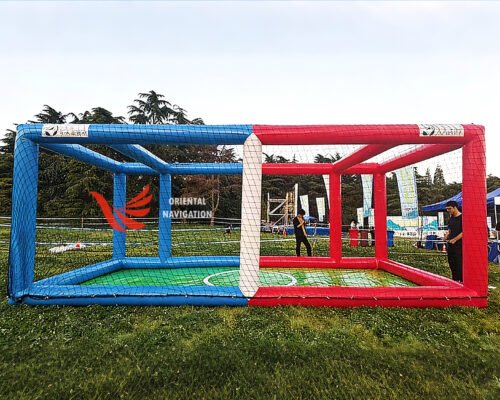
To prepare students for real competition environments, the training field should follow official B-ball drone soccer specifications.
Recommended setup:
• Distance from takeoff point to goal: 5 meters
• Goal inner diameter: 400 mm
• Goal center height: 2 meters
• Center line distance from takeoff point: 3 meters
• Clearance behind goal: 80 cm
Training with official dimensions helps students adapt to real competition conditions from the beginning.
3. Use Tail-In Orientation for Stable Control
Tail-in orientation is the foundation of beginner drone soccer control.
Training requirements:
• The drone’s tail always faces the pilot
• Maintain flight height at the goal center (2 meters)
• Hover for 1 second after takeoff to stabilize before moving forward
The tail-in view allows students to clearly see left or right drift and make corrections quickly.
4. Fly the Shortest Straight Path to the Goal
Once the drone is stable, students begin practicing straight-line goal entry.
Core Principle: Always Take the Shortest Path
Fly directly toward the center of the goal.
Avoid wide arcs or unnecessary turning.
Control method:
• Use the right joystick for small directional adjustments
• Use the left hand to maintain stable altitude
Smooth and precise corrections are more important than speed.
5. The Final 50 cm Before the Goal is Critical
The last 50 cm before entering the goal determines whether the entry will succeed.
Key technique:
• Retract the forward movement slightly before reaching the goal
• Do not wait until the drone is already inside the goal
Recommended entry posture:
The bottom of the drone passes through the goal first, followed by the front.
This creates a smoother and more controlled pass-through.
6. Retreat Immediately After Passing the Goal
After a successful entry, the drone must retreat immediately.
Correct retreat method:
• Slightly reduce throttle to lower the drone below the goal
• Pull the right joystick backward to fly straight back
• Avoid any side drifting
Important rules:
• Do not hit the goal frame
• Do not crash into the wall behind the goal
• Maintain smooth, controlled retreat
Immediate retreat helps maintain the rhythm required for continuous scoring.
7. Return to the Center Line Before the Next Entry
Once the drone retreats to the center line, the next attack can begin.
Typical training command from the coach:
“Back to center line — goal entry!”
Students repeat the cycle:
Entry → Retreat → Center Line → Entry Again
The focus is not on flying fast, but on building a consistent tactical rhythm.
8. 3-Minute Scoring Training Cycle
Students perform repeated goal entry attempts during a 3-minute training cycle.
Scoring rules during training:
• Successful clean entry: +1 point
• Hitting the goal frame: no point
• Failing to return to center line: no point
• Crashing into the wall: point deduction
At the beginner stage, stability and accuracy are far more important than speed.
9. Coach Corrects Common Beginner Mistakes
During training, the coach observes and corrects common mistakes.
| Common Mistake | Coach Instruction |
|---|---|
| Flying in large arcs | “Shortest path! Straight entry!” |
| Height instability | “Stabilize your throttle!” |
| Crashing behind the goal | “Brake earlier before the goal!” |
| Drifting during retreat | “Pull straight back!” |
| Flying too fast | “Slow down — stability first!” |
| Late corrections | “Adjust earlier!” |
The coach emphasizes three core principles:
Straight flight + Stable control + Consistent rhythm
These are the foundations of effective scoring in drone soccer.
10. Post-Training Reflection
After training, students should review their performance.
Questions for reflection:
• Did my drone fly in a perfectly straight line?
• Did I correct direction too late?
• Did I slow down before entering the goal?
• Was my entry and retreat rhythm consistent?
Reflection helps students improve faster by learning from both mistakes and successful attempts.
If you are a school, STEM center, or drone club interested in introducing drone soccer training programs, our team provides complete equipment and training solutions for beginners and competitions.
Feel free to contact us to learn more about drone soccer training systems.