1. Understand the Core of Offense-Defense Training: The Game of Breakthrough and Blocking
The coach explains to students:
Offense-defense training is not a formal game, but a practice of “real spatial judgment” and “flight movements under pressure”.
Three core goals of offense-defense training:
- Offense: Find angles → Seek gaps → Stable goal entry
- Defense: Hold position → Block routes → Leave no gaps
- Rhythm: Fast pace → Stable movements → High efficiency
Tell students:
“Offense is about finding space; defense is about blocking space.”
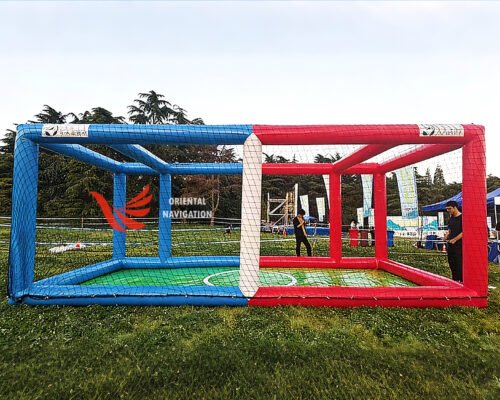
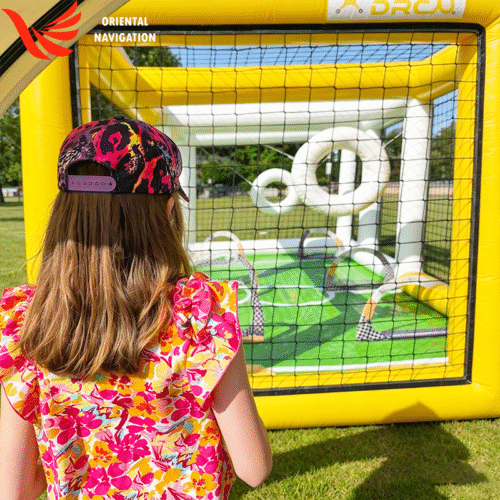
2. All Offense-Defense Training Must Be Conducted in a Closed Inflatable Field
This lesson involves collisions and close-range confrontations. All 1V1/1V2 training must be carried out in a closed inflatable field, and shall not be practiced in open spaces. Closed inflatable fields can effectively reduce the damage of drones caused by collisions and ensure the safety of training, which is also the standard configuration for official drone soccer training and competitions.
3. Unified Field Positioning (Applicable to Both 1V1 and 1V2)
Offensive side:
- Take off from the center line
- Hover first to test, then find breakthrough angles
- Do not rush to attack; observe the defender’s position and look for gaps to break through
Defensive side:
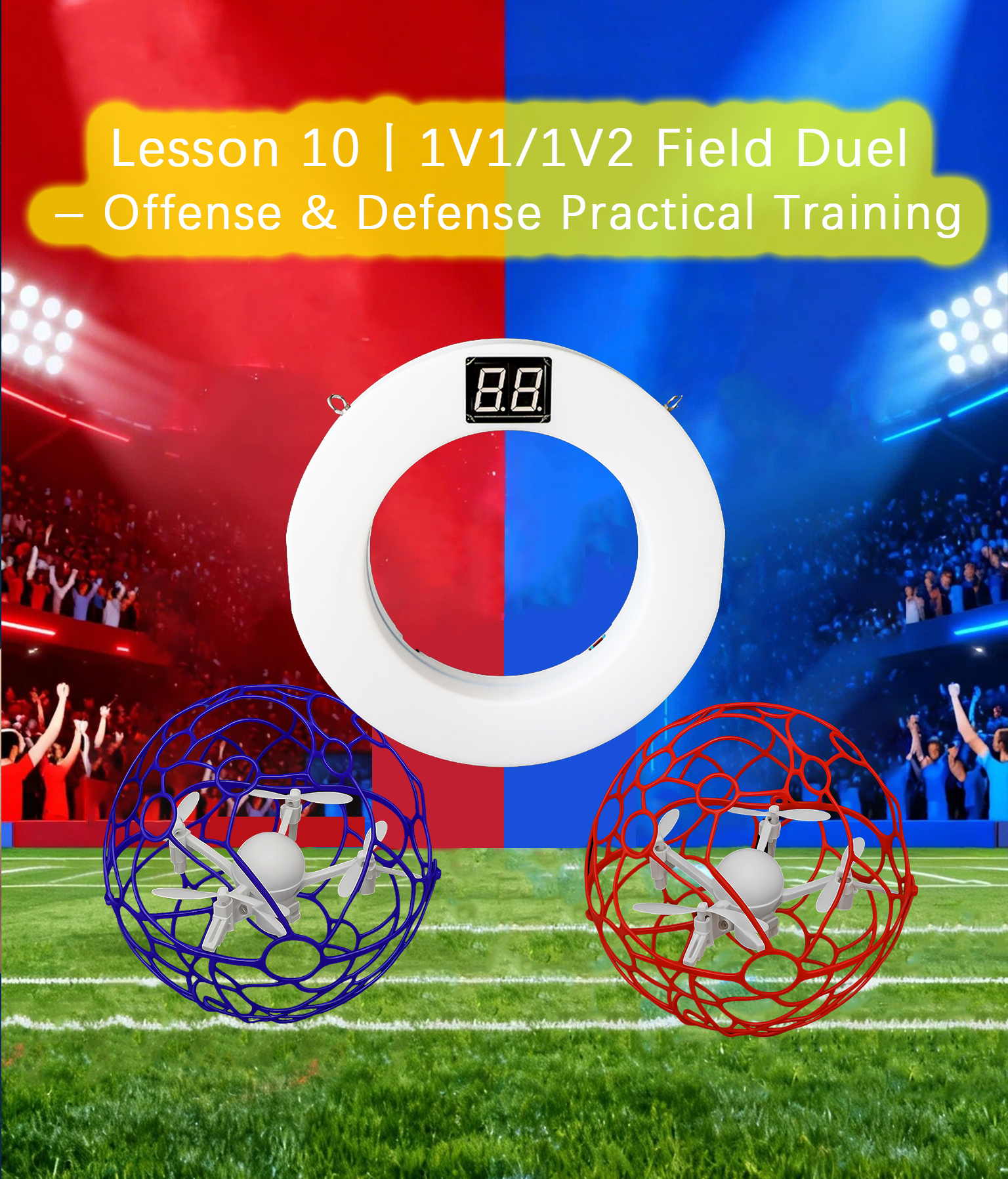
- Stand within one drone’s distance in front of the goal ring
- Keep the drone at the lower-middle position of the ring
- Do not chase the attacker; only block the most likely breakthrough routes
If there are only 2 students, conduct 1V1 training (1 attacker vs 1 defender).
If there are 3 students, conduct 1V2 training (1 main defender + 1 auxiliary defender).
The rules and movement logic are unified; the number of students only affects the participating roles.
4. Basic Principles for Defenders: Positioning Is Better Than Speed
The coach explains:
- The main defender guards the “central route” to block the most direct goal entry path
- The auxiliary defender (if any) guards the flanks to prevent angle breakthroughs
- Defenders must not crowd together, nor leave the area in front of the goal at the same time, so as to avoid leaving defensive gaps
Tell students:
“Defense is not about chasing the attacker, but standing in the position the attacker wants to reach.” This is the core logic of effective defense, which can avoid unnecessary energy consumption and ensure the integrity of the defensive line.
5. Basic Principles for Attackers: Create Breakthroughs Through Angle Changes
Attackers need to practice:
- Feints: Slight left and right swings to mislead the defender’s judgment
- Rhythm changes: Sudden stop → Acceleration to disrupt the defender’s rhythm
- Small-angle cuts: Find gaps and fly straight into the goal in an instant
- Close-range shots: The closer to the goal, the easier it is to break through the defense
The coach reminds:
Do not circle too large when attacking, as the defender will easily judge your route. Attackers should use small-range movements to change angles and find gaps, which is more efficient than blind rushing.
6. Offense-Defense Confrontation Process (Common to 1V1 and 1V2)
Coach’s command: “3-2-1 Take off!”
Process steps:
- Both sides take off and hover stably
- The attacker tests the defense, and the defender maintains their position
- The attacker looks for breakthrough points and tries to enter the goal
- Successful goal entry → Return to the center line to start the next round
- Successful defense (blocked routes or attacker’s mistake) → The attacker returns to the center line to restart
- Rotate roles in order after each round
Rhythm requirements:
Each round lasts 10–15 seconds, without delay, pause or random flying, to simulate the fast pace of real competitions.
7. Automatically Switch Training Modes According to the Number of Students (No Process Change)
✔ 1V1 Mode (When the number of students is insufficient)
- 1 attacker vs 1 defender
- Emphasizes offensive rhythm and defensive positioning stability
- Suitable for strengthening basic offense-defense concepts for beginners
✔ 1V2 Mode (When the number of students is complete)
- 1 attacker vs 2 defenders (main + auxiliary)
- More close to real game pressure
- Attack requires “angle difference” to break through the double defense, and defense requires “cooperative positioning” to cover all gaps
Both modes use the same process; the coach only needs to choose according to the number of students. The 1V2 mode is more in line with the actual competition scenario and can better exercise the attacker’s ability to find gaps and the defender’s cooperative defense ability.
8. Short Commands Used by Coaches During Training (Common to 1V1 and 1V2)
Offensive commands:
- “Change angle!”
- “Don’t crash hard!”
- “Find the gap!”
- “Keep the rhythm stable!”
Defensive commands:
- “Stand in the center!”
- “Don’t chase the attacker!”
- “Block the angle!”
- “Keep the height stable!”
Unified commands make training more rhythmic, help students quickly adjust their movements, and improve training efficiency.
9. Common Mistakes and Correction Methods
Common offensive mistakes:
- Rushing straight hard → “Change direction first, then attack!”
- Circling too large → “Make smaller movements!”
- Forgetting to return to the center line → “Return to the center line to start the next round!”
Common defensive mistakes:
- Chasing the attacker randomly → “You are guarding the goal, not chasing people!”
- Deviating from the central position → “Return to the center!”
- Being deceived by feints → “Stay stable, don’t move in a hurry!”
Timely correction of these mistakes can help students form correct offensive and defensive habits and avoid wrong movements affecting subsequent training and competitions.
10. Lesson Summary: Offense and Defense Are the Application of Basic Movements, a Necessary Stage for Competitions
The coach tells students:
- All basic flying skills will eventually be applied in offense and defense
- Accuracy is better than speed; stability is better than randomness
- Learn “positioning and angles” first, then “speed and rhythm”
Offense-defense training is the key step from “training movements” to “practical application”. It not only tests the mastery of basic skills but also cultivates students’ on-the-spot reaction ability and tactical thinking, laying a solid foundation for future team competitions and official events.